The Ps and Qs of WOM

There’s nothing quite like word-of-mouth advertising for your restaurant. It’s virtually free. It’s powerful. And, it can make or break your business. But how can you harness this positive force?

Here’s how:

  • Build excitement. Host special events, happy hour specials and community meetings at your operation. It will get new customers in the door and help existing customers see how involved you are in the community.
  • Internal marketing. Your treatment of your employees and your suppliers says a lot about the practice behind the scenes. Be sure you’re not only treating your team members with the utmost respect, but also arm them with the knowledge they need to sell your operation even when they’re not on the clock.
  • The tentacles of WOM. Don’t overlook just how far reaching word-of-mouth advertising can be. Once the ball is rolling, it can easily translate into newspaper stories, advertising, targeted direct mail, reviews, etc.

Keep in mind, this type of grassroots marketing takes patience, consistency and persistence, but the rewards will literally speak for themselves.

Don’t forget the saying, “Great marketing can kill a bad business.” Make sure your staff is well trained in exemplary service and profitable sales techniques to capitalize on increased traffic from word-of-mouth marketing. Click to learn how to develop a training program that gets results.


What Do Aliens and Waitstaff Trainees Have In Common?

When it comes to waitstaff training, your trainers are even more important than your trainees. So how do you select trainers and get them prepared? If their only frame of reference is how they were trained, they may not be equipped to succeed and the cycle of training shortcomings will continue.

Try this exercise at your next trainer’s meeting. Ask for a volunteer, then set the scene: “A barefoot alien has landed in the yard and desperately needs a pair of shoes. I’ll pretend to be the alien and, not knowing a thing about putting on and lacing up shoes, I’m going to follow your instructions exactly.”

The volunteer may have no idea of where to start or where to go. Others in the group may pitch in an idea or two. Whatever the instruction, it’s bound to be clumsy. You’ve tied your shoes thousands of times, but teaching another person to do it is difficult.

What matters? Getting the shoes tied. Yet folks involved in this exercise will often disagree about the “right way” to proceed. The point is that there are many right ways to tie shoes. Don’t argue about how to get there — just focus on the end result.

Trainers need to be certified to train in the same fashion as new employees are trained to work. Candidates should shadow a seasoned trainer in action, watching how he or she trains each topic. The trainer should ask questions to reinforce information, and “lengthen the leash” to let the trainee gradually take on more responsibility, even in the face of a mistake or two. That’s how people learn.

Excerpted from Now That’s Service That Sells!, the sequel to the best-selling book in foodservice history. Click to learn more!

Restaurant Training with Teen Employees – How to Make the Most of Them

We know we need them, especially during the busy times around the holidays, but we’re not always sure what to do with them or how to train them. After all, some of our best workers are teenagers… but then, so are some of our worst. How do we turn all of them into team players that perform well consistently (and not just when they feel like it)?

  • Don’t let them work too much. Research has shown that teenagers who work over 20 hours a week show high levels of psychological distress. If a doctor can detect it, so can your customers.
  • Keep them safe. According to the National Consumers League, a teen worker is injured every 30 seconds. Training should ensure that your teen employees can recognize hazards and are capable of following safe work practices. If they’re not, do everyone in your team a favor and let them go. Use video training to appeal to a teen’s need for visually based training.
  • Implement a buddy system. New hires have many questions, but teens often fear looking “stupid.” A one-on-one relationship with an experienced teen employee takes the pressure off and makes the new hire more productive and safer.
  • Be specific. Every parent knows that if you want a teen to do what she’s asked, you need to be very specific about the task. And, because teens have shorter attention spans than adults, you also need to be brief. Consistently and specifically restate your expectations until the behavior you want is happening.
  • Model the behavior you want. Don’t expect teens to know the rules or what’s expected of them. Role play with experienced employees in team meetings and point out basics (smiling and greeting customers, asking permission to remove a plate, filling water glasses courteously, etc.). If you don’t show them what you want, you can’t expect them to deliver it.

Video training in DVDs can help teen servers understand the sales techniques you need implemented in order to increase sales. Take a look at our real-world DVD training series with something for everyone!

Train Servers with Role-Playing to Sell the Holidays Sooner

The best server training strategy is practice. Try this waitstaff role-playing strategy with your team to generate leads for all types of holiday gatherings.

Server: Thanks again for coming in tonight. Did you enjoy your evening?

Customer 1: Yes, very much!

Server: Great! If you’d like to share this experience with your co-workers or family, we’re taking reservations now for holiday parties and catering events. Do you have any plans?

Customer 2: I haven’t even thought about the holidays yet!

Server: I know what you mean, but we book up so quickly and I like to give our customers the first shot at our prime times.

Customer 1: You know, our Bunko group wanted to have an ornament exchange in November. Maybe I should reserve a table now. There’ll be 12 of us.

Server: Great! Let me get you our hostess and we’ll make sure you have a great spot.

Customer 1: Thanks!

Need more ideas to make your sales sizzle, instead of fizzle? Click here.

Quick Waitstaff Training Tip: Recommend a Large

When you train your servers to sell effectively, your profits will increase and so will their tips. Everyone wins! Training servers to recommend the larger size is a simple but powerful sales strategy, particularly effective when selling beer. Conduct a quick waitstaff training session that covers these tactics:

  • If a guest orders something on draft, always say “Large?” as you nod your head up and down.
  • If a guest orders any other beverage that comes in different sizes, always say “Large?” as you nod your head up and down.
  • Recommending the large size gives guests a better value, earns you more tips and can save you steps. How many times has a customer ordered a small beverage, gulped it down, then sent you off running for another one, usually another small? Save yourself the wear and tear. Think big.
  • While you’re at it, think “pitcher” if two or more guests are ordering the same brand. The most effective recommendations highlight the value: “How about a pitcher? You end up getting an extra glass for free!”

Waitstaff training - beerAlways recommending a large is just one way to increase beer sales. Want more? Check out this innovative DVD in which real-life servers share their secrets about beer-selling success.

Restaurant Training: It’s What You Do

When you think of the most effective and successful leaders, you probably think of the most charismatic ones. They exude passion and energy, and people stand in line to just to have a chance at being a faithful follower. But don’t run out and buy your magic set just yet. While charisma can go a long way toward motivating a group, maintaining positive momentum during day-to-day resaturant operations comes from getting your hands dirty, not shining with the stars. The most important “restaurant training” you do is simply what you’re doing… day in and day out. Your waitstaff is always watching you, and will follow your example even if it goes against what you just taught in a waitstaff training session. So be sure you:

  • Admit your mistakes when you make them, and allow everyone to learn from them.
  • Praise good work publicly. It shows you’re committed to your cause.
  • Accept criticism when it’s given to you constructively and appropriately.
  • Remember that how you do things is often as important as what you’re doing.

No train? No gain! Meeting your goals for the new year requires a solid training action plan. Learn how to execute effective training with our easy-to-read No Train? No Gain management handbook. Click for more info.

Role-play: Upsell Well Drinks to Premiums

Let’s face it: the Absolut (or Stolichnaya or Grey Goose) tastes better than the house vodka. That’s why they cost more. Upgrading mixed drinks to premium drinks can boost your bar profits a little at a time… and create a better drink for your guests. Train your waitstaff and bartenders on details about some of your nicer premium spirits and, before your next shift, try this role-play activity with your servers and bartenders:

Guest: I’ll have a gin and tonic.

Server: Would you like Beefeater or Tanqueray with that? Or do you care for another type of gin?

Guest: I don’t know. Is there something wrong with the house vodka?

Server: No, sir, but I find that it’s a completely different drink with a nice vodka. My favorite is the Grey Goose. It’s made in France and distilled and bottled in very small batches. It’s incredibly smooth.

Guest: Go ahead and bring me one!

Need more ideas to improve bar profits? Check out the Pour on the Profits Bar Sales Training Program. Watch a clip from the DVD below!

Real-world Waitstaff Training

Role-playing is a perfect way to give servers an opportunity to practice dialogue before they approach guests with it. Follow these guidelines to make the role-playing exercise worth the effort.

  • Establish real-life examples using props and co-workers playing the part of guests. Create a set of scenarios that explore different guest experiences.
  • Remind all parties involved that this is a learning environment and that staying in character is important. It’s okay to have fun, but not at the expense of the learning.
  • Don’t allow the participants to over-embellish a situation. This is role-playing, not acting class. For example, someone playing the role of an upset guest should act the way most upset guests act, not like the exceptional guest who starts yelling and storms out of the dining room.

Get more restaurant training ideas in No Train? No Gain!, Developing And Delivering A Training Program That Gets Results

Role Play: Pair Wine with Desserts for Increased Sales

After-dinner drinks are great ways to bump up bar profits, but what about the guest who says, “I don’t do the hard stuff” and turns down the Irish coffees and Grasshoppers? Train your waitstaff how to suggest wine with desserts by pairing them well.

Server: Our specialty dessert tonight is a six-layer chocolate cake with mocha filling and fudge icing. Can I bring you a couple?

Male guest: I’ll try it with some coffee.

Server: Great! We also have a wonderful, dry cabernet that goes perfectly with chocolate and coffee. Would you like try a glass?

Male: OK!

Server, to female guest: Can I bring you a dessert?

Female: The cake’s too much for me. Thanks, anyway.

Server: How about some fresh fruit and some sparkling wine? It takes great together, especially with our strawberries. It’s light and sweet and a perfect finish!

Female: Sounds perfect!

Looking for more ideas to increase your wine sales? Train servers to pair wine effectively with a variety of menu items with the Real-World Selling: Wine DVD. Check out an excerpt here: 


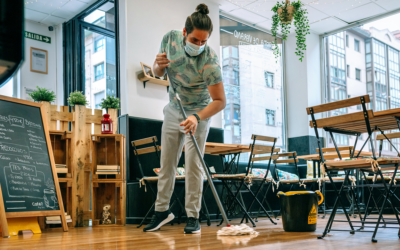
Grime Doesn’t Pay – Keep Your Restaurant Clean

It’s hard to keep things clean if you aren’t aware of them. But paying attention doesn’t have to be a full-time job. The important thing is to know when and where to look for cleanliness problems.

Your customers care about at least three things: the appearance of your staff, the appearance of the restaurant grounds, including the parking lot and entryway, and the appearance of the entire dining room, including service stations, cashier areas or bars. You’ll need to turn on your grime radar whenever you monitor each of these areas.

First, teach servers to pay attention to themselves by turning on their personal radar. For example, encourage them to take a peek in the mirror as they’re getting dressed before their shift, when they visit the restroom or after a break. Your restaurant has spent a considerable amount of time, energy and money to present the best possible image to your customers. That can all go to waste if servers are not clean and presentable.

The next opportunity to switch on your radar is whenever you’re working the floor. You should constantly be searching for any cleanliness problems throughout the various stations and work areas.

Finally, take a look around whenever you enter or leave the restaurant. Your customers will notice the condition of your parking lot, your entryway, your signs, your windows, etc. So turn on your radar as soon as your restaurant comes into view — and keep it on until your restaurant drops from sight as you leave.

Use the Grime Doesn’t Pay DVD to help your employees see your restaurant the way a guest may see it. Check it out below:

Next Page »